Price the exit for the day you can least afford it
A platform, a vendor, a rule that names a person: each exit takes whatever you're short of on the day you leave. Unfundable then, the commitment is permanent.
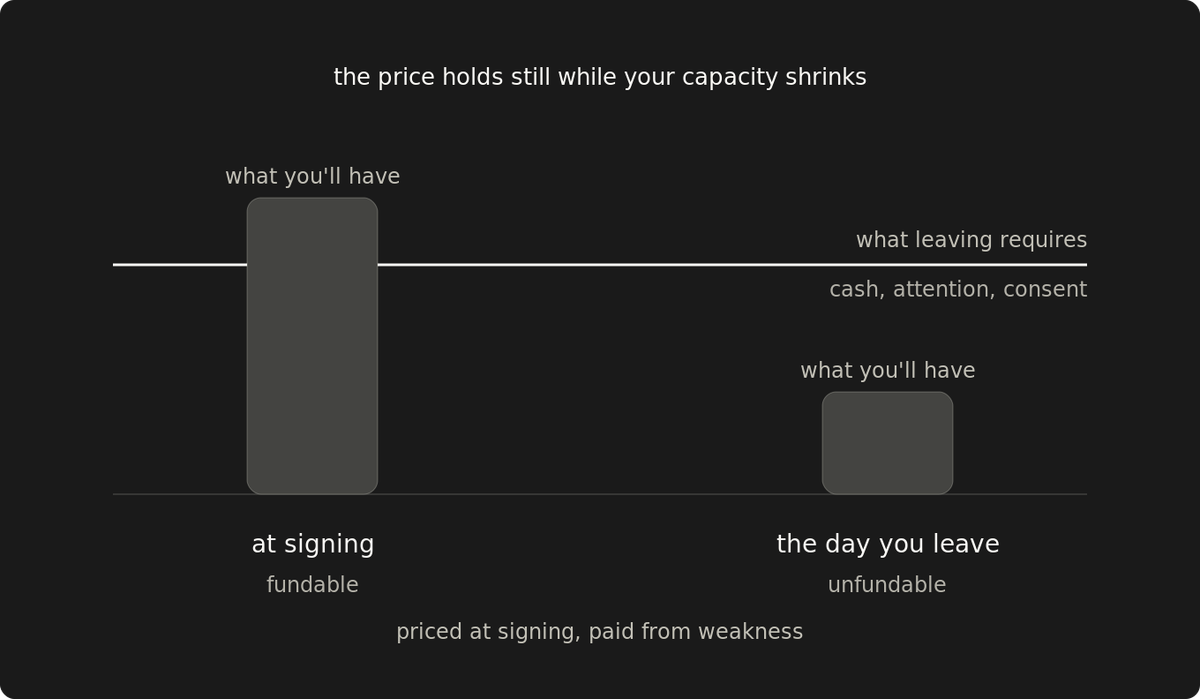
A platform agreement is reversible on paper. Whether it is reversible in practice depends on what leaving costs on the day you can least afford it, and a commitment whose exit you can't pay from weakness is permanent, whatever the contract calls it.
The exit is paid in whatever the leaving party is short of on the day it leaves. Cash. The engineering attention a migration takes. One person's consent. The switching cost written down at signing is counted in today's cash and today's team, so it answers a question nobody will be asking on that day.
A pipeline you can't afford to rebuild never leaves the platform
Take a platform agreement and the deployment pipeline built on that platform's features, its triggers and its pull-request checks. Leaving means rebuilding the pipeline, and the rebuild is paid in the attention of the team that runs it.
The reason to leave arrives on a schedule the team doesn't set. Sometimes the date is on the contract: a term ends, and the date belongs to whichever side has to act by it. Sometimes there is no date at all, only a bill that outgrows the budget it was approved against. Either way the attention was never reserved. When the day comes, the source is in every clone, but the pipeline definitions and the review and check history live on the platform and leave with it. Every run of the pipeline still passes. Nothing is broken, so nothing is prioritized, and the roadmap work the rebuild would displace keeps its slot. The platform never gets replaced.
A move off a hosting provider has the same shape one layer down. Every system stays live during the move, so the same people run the old stack and the new one at once, and the price comes out of the margin the commitment earns.
Exit terms hold still while your capacity shrinks
Entry is built for everyone who might take it. Exit terms are written once. A vendor's termination terms assume the migration budget that existed at signing. The customer leaving because the bill outgrew that budget meets the same terms with less to meet them, and the terms don't move to fit.
That asymmetry needs no intent.
Some terms are paid in a person
Some commitments don't need a counterparty to trap you. A rule that only the people it names can change needs all of them available, and the moment it has to change is the moment one of them isn't. A credential issued in a person's name doesn't transfer. Anyone else who renews it issues it again from the beginning, and the lapse is how you find out it was person-bound. A function that runs through one person can only be moved off that person with that person's hours, which are the hours the function is already consuming.
Cash exits at least come with a number. The ones that need a person's consent have no number until the person is in the room, and none at all once they're gone. Those get inventoried first, because nothing announces their date.
The cheap exit is bought at entry
Leverage runs one way. The exit is cheapest while the other side still wants the deal, and the surest such moment is the signature. Whether the price is zero depends on who needs the deal more. A term the counterparty prices is still purchasable at entry. It goes in as a line in the deal's cost, approved by whoever approves the cost, because the function that would do the leaving asked for it. Later, the other side has less reason to sell it, and by renewal it knows what leaving would cost you.
A buyer sizing up a small vendor is weighing what happens if the vendor disappears. A vendor whose terms hand over the artifact at the end of an engagement, with its source and a license that outlives the engagement and lets anyone else maintain it, has answered that fear before it's asked. That is what makes a small vendor signable at all. Where the engagement produces an artifact, the buyer's version of the term is the same artifact, runnable without the vendor.
The architectural version is the same move made without a counterparty. A pipeline whose hosts pull from a git remote on their own schedule needs a remote address and a key from the forge and nothing else. Replace the forge with another forge or a bare server, re-issue the key, and the deploy scripts don't notice. That moves delivery off the platform. The checks are a separate coupling. Owning the platform avoids a one-time migration cost by taking on an ongoing one: the attention it takes to keep the platform running. That obligation keeps falling due whether or not the team can spare it. It is the better trade only when the ongoing cost is small enough to carry through the thin year.
Some exits have no cheap version
A regulatory regime with continuing obligations. A marketplace that owns the reputation you built on it. A running service sold on standard terms, where no exit clause is on sale at any leverage. These offer no term that changes the exit, so what leaving requires can't be negotiated down. A requirement you can't negotiate is a different thing from one you can't meet. A fixed requirement the function can meet from weakness is expensive and reversible. One it can't meet is permanent, and pretending a cheaper term exists is how that stays unpriced. Some of these you enter by growing into them, with no signature anywhere, and the decision moment is the forecast that puts the crossing in view.
Enter the permanent ones knowing they're permanent, and accept that in the entry decision. If the value captured justifies a commitment you can't leave, the commitment is fine. If it only justifies a commitment you can leave, don't enter.
Ask what leaving requires, and whether you'll still have it
The exit goes unpriced because the person who will pay it is a future version of the signer, with less of whatever it takes, and that person isn't in the room.
So put them in the room. Before anyone writes down a switching cost, the function that would do the leaving answers two questions: what does leaving require, and will we still have it on the day we need to leave? Where a cheap exit is available, it gets written in at signature. Where the answer to the second question is no, the commitment is permanent, and someone who answers for the function accepts that on the record before the signature, or the deal doesn't go ahead.
The ones already signed have the answer they have. Dated ones with attention still unreserved go first, and reserving attention means doing the rehearsed part of the move while the team is whole, because attention doesn't bank. The next planning cycle spends whatever was set aside. The person-dependent ones you inventoried first go next, and the move is to shift the rule or the credential off the person now. Stop deepening only the dependencies you still mean to leave. Anything entered as permanent on purpose gets used without apology.
The ones you couldn't leave on that day are permanent. The term sheet doesn't get a vote.