A constraint you can fail overrules your architecture
An architecture can clear every performance spec and still fail a line that has nothing to do with speed: a price ceiling, a margin it quietly destroys.
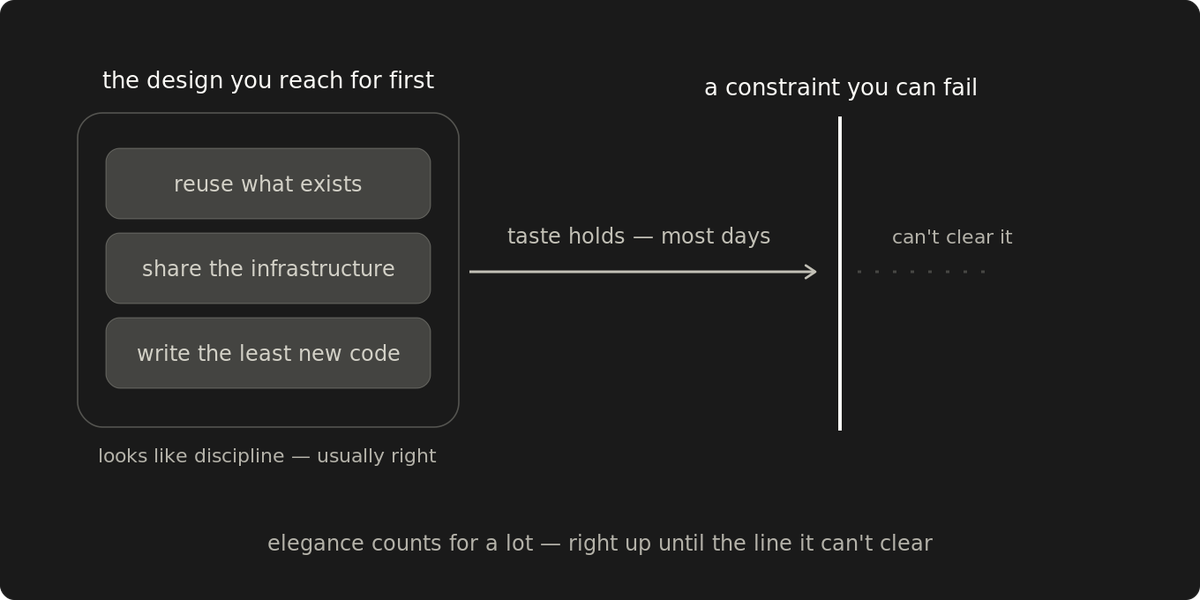
The architecture you reach for first is a preference.
The preference comes with reasons: reuse what exists, share the infrastructure, write as little new code as you can. Good instincts, and most days they land on the right design. But they land on it by taste, and taste holds only until a constraint you can fail says otherwise.
A constraint you can fail narrows the field
Plenty of architecture debates come down to preference. Shared or dedicated. One service or several. Two engineers trade defensible reasons, and the room never converges, because taste has nothing to converge on.
That changes when the constraint comes with a line a design can miss: the measured load it must carry, the ceiling it must clear. "It needs to be fast" draws no line. Designs that can't clear the line drop out. Usually more drop out than the debate assumed, and what's left is a short list the line alone can't rank further. The engineer who drew the line shrank the argument to the part still worth having.
This is why reviews stall. The line that would settle them was never drawn. Sometimes it's already sitting in a measured load or a contracted SLA, and nobody pulled it. Sometimes it doesn't exist yet, and someone has to commit to one. Either way, until that line is on the table, nothing settles the room.
A constraint only matters when a design can miss it
A bare performance target seldom forces the call. The usual escape hatch is to spend: a bigger instance, another replica. That covers most targets, so the design rarely has to change to meet one. A target with no failure condition decides nothing.
A fixed price shuts the hatch. Performance now has to land inside a cost ceiling, and a ceiling is something a design can miss. That is the version of the constraint that forces architecture: the one you can fail.
The sequence often runs backward from the textbook, too. The ceiling can arrive before the design work starts: a contracted rate, or a market the product has to price into. A number you didn't choose is still the clearest brief a design ever gets.
Fix the price first, and the field narrows on its own. Designs that only clear the target by spending without limit stop counting. What remains are the ones that clear it within the ceiling, and there are usually fewer than anyone argued over.
Sometimes the design you ranked last is the only one that fits
Sharing is usually the cheaper instinct, and usually it earns its rank. Pool enough independent workloads and their peaks rarely line up. The combined demand is smoother than any single workload, so shared infrastructure carries all of them on less headroom than each would need alone. That smoothing is why the reuse instinct ranks sharing first.
The instinct rests on one assumption: no single workload dominates the pool. When one does run larger than the shared system was built for, there is nothing to average it against. Force the shared system to stretch around it, and everything else on that system degrades. The pooling that made sharing cheap is the exact thing this workload defeats.
Give that workload its own infrastructure. You pay more to run it, but you size it to a load you can actually measure and stop paying for everyone else's worst-case. Under a fixed price, that is often the only design left standing: the one the instinct ranked last, losing on taste and winning on the numbers. Dedication holds a quieter saving, too, because a system carrying a single workload skips the overhead of sharing.
Some lines never show up on a benchmark
Money makes the constraint easy to see, because you can fail it on a spreadsheet. Other lines cut as deep, and some have nothing to do with performance. An architecture can clear every latency and throughput target and still erode margin past what the business can carry. The same design might demand support the price was never set to cover, or make each deployment so costly that selling it twice stops paying off. Green benchmarks say nothing about those lines, and those are the ones that decide whether the design keeps its place once the business starts paying for it.
What to ask at your next review
Next time an architecture debate won't converge, put one question on the table: what line does this design have to clear?
Ask it out loud, to the room. The peak it has to carry, the ceiling it has to fit inside, the margin it can't cross. If someone can name that line, the field narrows in front of everyone, and the argument drops to the part that's left. If no one can, you have your answer anyway: the decision isn't ready, and no one has drawn the line that would settle it.
Elegance counts for a lot, right up until the design meets a line it can't clear.