Migrate one variable at a time, or you won't know what broke
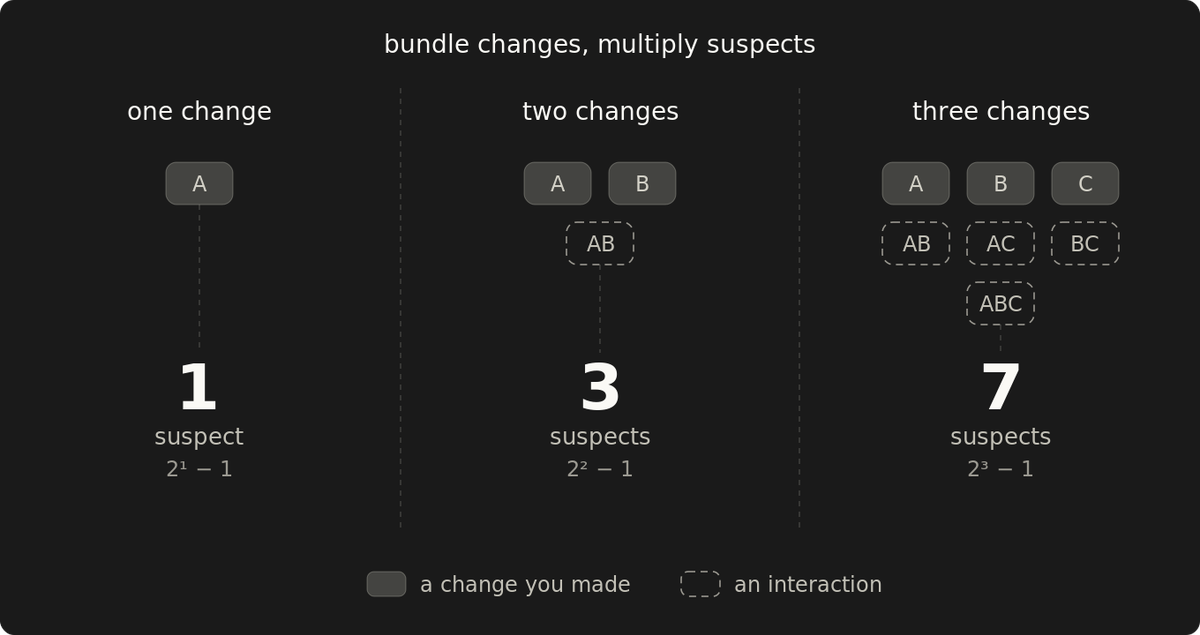
Hold every variable but one and a failure has one suspect. Bundle two and the suspects grow like the subsets: three places to look, then seven.
A system change is a controlled experiment.
One variable moves, and everything else holds still: the feature set, the underlying versions, the behavior other systems depend on. Hold that line and a failure has one suspect. The change broke it, and the only open question is which part of the change caused it. That attribution assumes nothing outside the change moved either: an upstream deploy or a neighbor's mid-window change adds a suspect you didn't introduce, which is why the surrounding surface gets frozen too. Let a second variable move at the same time, and you haven't doubled the risk.
You've given up the ability to attribute the failure to any single variable: the break stops naming a cause and starts handing you a list of suspects.
You scope a migration by what it holds fixed
The usual way to describe a migration is by what moves: a new platform, a new datastore, or a new cluster. The more useful description is the inverse: the list of things you've promised will not change while the one thing does. Those are the migration's invariants, and that fixed list is its real specification. Write it down, and it's concrete: the request contract holds, the data format holds, the versions hold, the on-call runbook still applies.
A variable, here, is something observable from outside: a contract, a version, a behavior a neighbor depends on. Not an internal detail. The new platform can change a thousand things inside itself and still be one variable, as long as everything observable above it holds. The rollout surface isn't a variable either, as long as the change stays compatible with the half-migrated system. You ship it to one place, then ten, then everywhere. That varies where it lands. What lands is identical everywhere.
Every item on the fixed list narrows the search before anything breaks, and the one you forget to list is the one that walks in through the door you never locked. When the system fails, you don't start from "what in the whole system went wrong." You start at the single bounded change that moved. It won't name the root cause, but it draws the perimeter the cause lives inside, and that's the difference between a question you can answer and a search.
One variable per validation window looks like the slow path. It's the cheapest debugging tool in a migration: hold everything else fixed, and a break has one place to look instead of the whole system. I argue for it harder than for almost anything else in a migration plan.
Each extra variable multiplies the suspects
Move two things at once, and the failure no longer has to live inside one of them. It can live in the interaction between them, where the version bump meets the new feature: a break neither one produces alone. Now there are three suspects: the first variable, the second, and the pair. A third variable adds four more: itself, its pairing with each of the first two, and all three at once. The count jumps to seven. The search space grows like the non-empty subsets of your variables, not the headcount.
The interactions are the expensive part. A failure inside one change has one place to look: the thing you moved. Even when the cause is subtle, you know which diff it's in. A failure that only shows up when two changes meet is in neither diff alone. Both are correct on their own, and only when run together do they reveal they're incompatible. Those failures eat days, and bundling manufactures them.
"While we're at it" is the most expensive phrase in a migration
The pull to bundle is structural, and it's rational until the moment something breaks. A validation window's overhead is mostly fixed, whatever it carries: the staging runs, the approvals, the off-hours execution, the validation. Spread across five variables, the per-variable cost drops to a fifth, and bundling looks like the efficient move.
The bill comes due at the failure. The window you saved buys a break with five variables in play and the entire interaction surface between them, on the change you cared about most. The instinct to bundle peaks exactly where attribution matters most.
Hold the contract and the break has one suspect
The cleanest single-variable change swaps an implementation while the contract above it holds: same inputs, same outputs, same guarantees every neighbor was built against. That includes the latency band their timeouts were tuned to, and a swap has to re-prove that band before claiming the contract held. A neighbor sees the change happen, but never a different answer. Get that right, and a break has one suspect: the thing you swapped, because it's the only thing you moved.
The contract doesn't hold itself, though. You hold it on purpose, which means pinning every axis that touches it, down to the improvements the new implementation makes possible. Those get logged and deferred, even as they sit right there.
Better still, put the rule in code. A system that refuses to apply more than one version step per run can't be talked into a second one by a deadline, only by a deliberate, logged override you have to mean. The constraint lives where pressure can't argue with it, which is where you want it mid-change.
A clean rollback can't tell you what to change
Preserving invariants gets confused with maintaining a rollback path, because both appear in the same careful migrations. They're different instruments.
A coexistence migration keeps the old system alive so that traffic can be routed back to it. That buys a way home. It says nothing about why you needed one. Grant the best case: you changed five things at once, the rollback is flawless, traffic goes home, the old system catches it, the incident closes. You sit down to try again, and you still don't know which of the five to fix. Reapply them one at a time, and you can find a suspect, but only by re-breaking production attempt after attempt, and an interaction between two of them can still pin the blame on one. The invariant set tells you before the first attempt. That's the difference between surviving a migration and understanding it.
Sometimes the variables won't separate. A new platform won't run the old version, so the upgrade rides along whether you invited it or not. When you can't get to one, the rule changes shape instead of breaking: collapse the coupled variables into the smallest bundle the migration can't proceed without, treat that bundle as your single variable, and test it as one. When something breaks, you'll know the bundle did it. The culprit inside stays unnamed, a cost you take on with your eyes open. Aim for the minimum the change forces, and refuse to add anything past it for convenience.
So the next time a change wants to carry a passenger, the version bump that's due anyway or the cleanup that's right there, ask the one question that will matter under pressure: if this breaks, will I know which one did it? If the answer is no, the passenger waits.
Each one you wave aboard is another axis to rule out the day attribution matters.