Cloud cost optimization is an influence problem
Cloud cost optimization becomes an influence problem past the configuration layer, where the savings live in code another team owns and answers for.
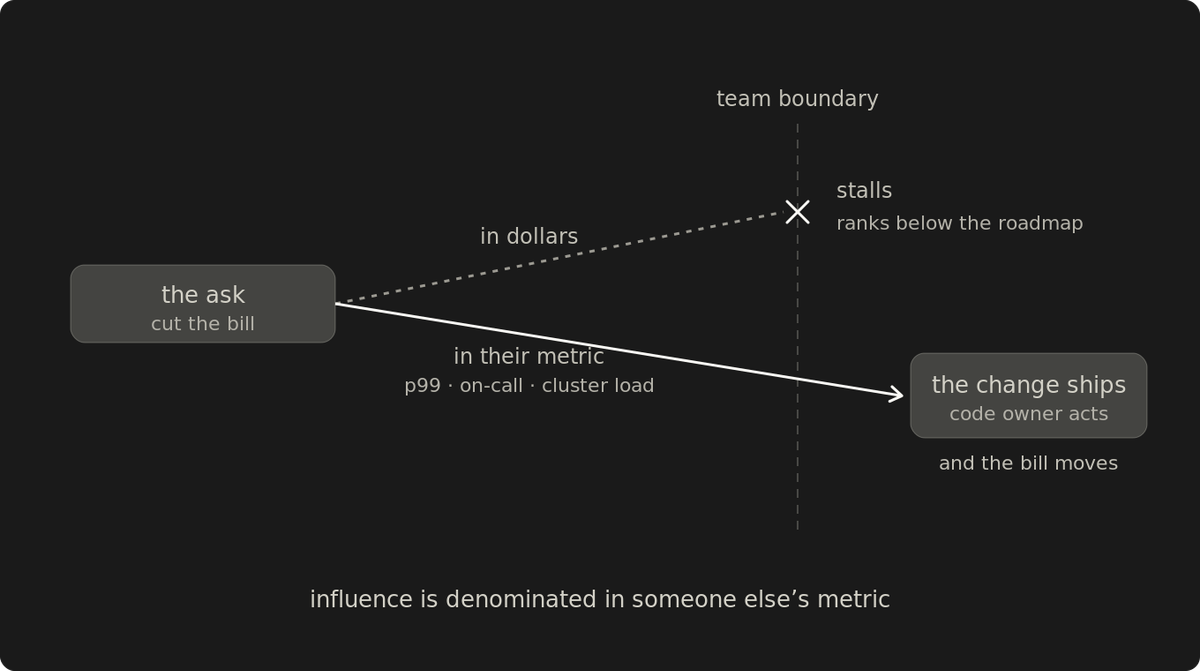
A cloud bill has two layers. The first answers to configuration. The second answers to the metrics of the team that owns the code. On that second layer, cloud cost optimization turns into an influence problem.
Configuration is the first layer: autoscaling, resource allocation, orphaned instances, idle schedules. Those savings land within a billing cycle. The second layer is application behavior: queries, retry logic, cache, connection handling. The engineers who write it are measured on shipping features. The bill never enters their review.
Both layers are engineering. Only the first answers to whoever holds the number. Past that layer, the next dollar can't move without a change only the owning team can make. The bill responds to influence, or it stops moving.
The cost and the lever sit in different columns
The bill lands on one team; the code that drives it belongs to another, where cost ranks below the next feature. A query that scans more than it should, a cache rebuilt too often, a batch job still sized for last year's peak and running on triple the nodes it needs: each is a line on one team's cost report and a non-event on the other's. No part of the org chart closes the gap between them.
This is where the engineering framing breaks. Find the waste, fix it. That's the model for the configuration layer. Past it, finding the waste is the easy half. The dashboards point at it, or at least at the service, if not the exact line of code. The hard half is that the fix belongs to someone whose incentives point elsewhere, and whether to make it is their call.
Authority stops at the team boundary
There's no authority to apply. Some of these teams are external vendors, working off a contract and a statement of work rather than a reporting line, so there isn't even a chain to escalate up.
The obvious move is borrowed authority, a management mandate. It works, narrowly. A mandate buys the smallest version of yes: the change made once, to spec, by people who'd rather be on their own roadmap and who won't flag the next expensive thing, because finding it was never their job. The ticket closes. Nothing changes about what the team is trying to do. And authority is a balance that draws down with every use. Spend it twice, and the third request arrives from someone the team already files under "goes over our heads."
So authority moves one line and spends the relationship that would have moved the next ten. It's the most expensive currency available. Spend it last.
The best saving is also their win
The useful targets are the ones where expense and operational pain share a root cause: a system that's oversized, chatty, or left alone long after anyone last tuned it. On those, the change that cuts the bill is already on the owning team's wish list under a different name.
Right-size that batch job and the compute line drops; the same change stops it from saturating the cluster the team's own service runs on. Rewrite the query and scan cost falls, and the p99 the team's users keep complaining about comes down with it. Move static files off the VMs that served them, and the VMs can retire: the hosting line drops, and the patching the team carried goes with it. Same change. Different column.
So the ask names both sides: there's a cost target, and the change that meets it also fixes something the team already wanted fixed. The conversation centers on their problem because it is now the reason to act. The saving rides along.
There's a test for whether the overlap is real, run before the pitch: could the team call this change a win without mentioning the cost target? If yes, it holds. If no, the change is purely a cost to them and a saving on the bill, and calling it their win is a lie that dies the first time they look closely, taking the credibility behind the ask down with it.
When the test finds no overlap, that's the diagnosis. The cost goal and the team's metric diverge, a structural conflict no framing closes. Then escalation is the move that's left, because the cheaper path is already gone.
Before any cross-boundary cost ask, find the thing the team is already chasing that this change also delivers. Find it, and the ask is denominated in their currency, and the bill takes care of itself. Come up empty, and escalate on purpose.
Visibility isn't incentive
FinOps starts with visibility: a price tag on each service, shown to the team that owns it. That puts the number in view while the lever stays with the owning team.
The price tag names what the code costs and stays silent on what the team is rewarded for—even chargeback, which puts the cost on the team's own budget, only changes who pays. What the team is rewarded for still doesn't move. Getting chargeback installed across teams that resist it is this same influence problem, just harder. The dashboard reveals the gap and leaves it open.
A lot of this waste never reaches the cost owner at all, because the team kills it themselves; a sloppy service grates on whoever runs it. The influence problem lives in a narrower place: the cost lines where the fix loses to shipping the next feature on the team's own board. That's where the bill gets stuck.
The relationship outlasts the project
A team handed a win, whether a quieter on-call or a maintenance load lifted, treats the cost owner as someone who makes the system better. The next expensive pattern arrives before it hits the report. The project that opened the relationship closes; the standing it built doesn't.
Treat cost as one team's job and the savings stall at the configuration line, past which every remaining dollar needs someone else to move it. Past that line, the number answers to influence.
And influence is denominated in someone else's metric.