An accepted cost is a decision nobody is making
A number that never moves reads as normal in every review it passes through. Reopening one starts with a question: Who went looking for the cause?
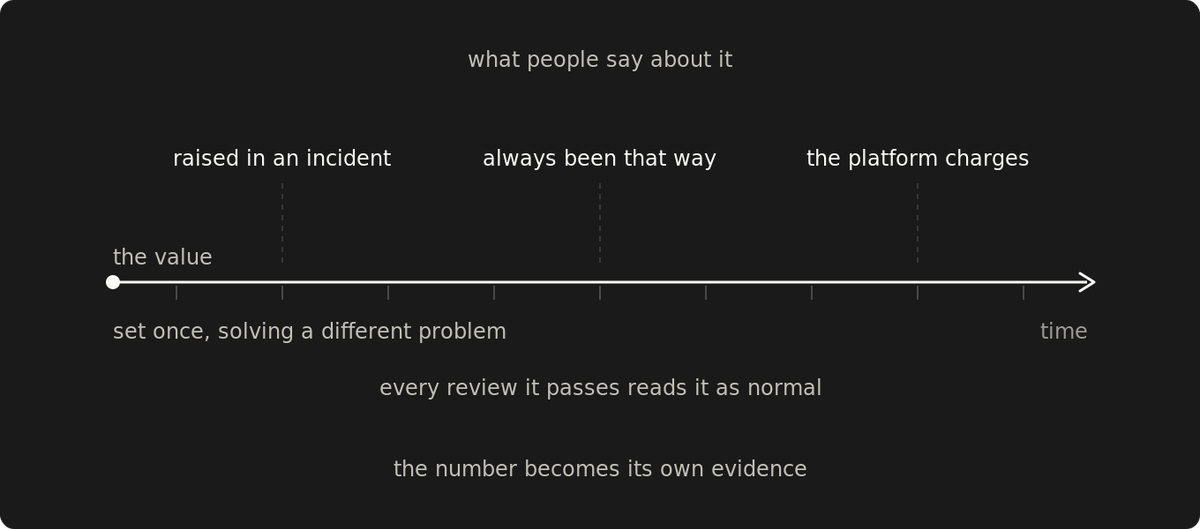
"That's just how it works" describes the team's model of the system, not the system. The number it defends was set once by someone solving a different problem and has remained unchanged ever since.
The bill that's "what the platform charges." The page everyone opens in a second tab while it loads. The error rate a nightly job cleans up after. Each entered the system as a choice, and the choice is still running.
A capacity number increases during an incident and never decreases. A tool gets installed the way its quickstart said. The value holds, and the label above it changes: in year one it reads "we raised this during the incident," and by year four it reads "that's what the platform charges."
The number becomes its own evidence.
The tell is a sentence that ends the investigation
"It's always been that way." "That's just how the service works." "We've tried; nothing can be done." Each one closes the question at its first step and sounds like a finding.
A number nobody questions is the same sentence unspoken. Costs, latencies, and error rates that never move don't announce themselves, because a number that doesn't move reads as normal in every review it passes through. Ask what the reason was. A setting with no reason written down anywhere is a candidate, and so is a setting with no one left to ask.
The filter's job is to say no
Asking whether a default is real takes a sentence. Answering it can burn a week of someone's time. Four questions stand between the two, and they do different jobs. The figure decides whether the answer is worth buying. The record says whether the number is a candidate at all. The workaround sets priority among the candidates, and age breaks the close calls. Running all four takes minutes.
The record turns on one thing: somebody measured this number against this workload and wrote down when it was done. A benchmark qualifies only if the conditions it ran against are still in production—absence answers in seconds, which keeps this question cheap. A written rationale proves that a decision was made, which is a different question from whether the number still fits. Documentation settles what a service does. A design doc or a comment left by whoever set the value offers a claim about the mechanism, which is something to test. A quota table records what the platform enforces. An adjustable number without a benchmark is only a starting value. A fixed architectural limit ends the tuning inquiry. Whether the architecture is worth changing is a different investigation.
The workaround asks whether anyone looked for the cause or only for a way around it. A retry wrapper, a cache, a nightly reconciliation job: somebody built a box whose sole purpose is to route around this, and somebody maintains it. The box is on the books. The cause is on nothing, which is how it survives.
The figure weighs a year of the default against the time it takes to get the answer. A latency nobody notices on an internal tool never justifies that week. A line item large enough to put its own system under review clears it many times over. That gate also makes a confirmed default survivable. Anything that reached the week was already worth the week before anyone knew the answer. Where you can't produce the figure inside the minutes this filter takes, an order of magnitude is enough to sort by. Exposure posts no annual figure and clears on irreversibility: whether one occurrence is something you could not undo. Almost every system has a path to something unrecoverable, so the question is whether the workload walks it.
Age breaks the close calls. Date it by whatever record exists, the setting's last change, or the generation for which the value was written. The library it was sized for has been superseded, and the traffic it was sized against is gone, so the case that justified it may simply have expired.
Expect that what clears the filter turns out real. The limit is the limit.
The filter also runs one number at a time. A default copied across many small systems fails the figure in each of them and would clear it in aggregate.
The cause sits where nothing reports
Separate the symptom from the cause. The symptom is what the budget shows; the cause usually lies a layer beneath it. A workload reaches provisioned capacity, and the service starts refusing work. The client treats each refusal as an error, so capacity increases until the errors disappear. Nobody checks whether the workload requires a new ceiling or needs a way to wait. Whoever runs the next review sees no errors at that capacity and records it as demand.
The layer beneath the symptom is often the one nothing measures. A server-side span excludes what happens on the client. An API that responds in milliseconds and a user still waiting are both true at once, but only one appears in the server-side telemetry. The gap is where the compile step lives, where the render-blocking asset lives, and where the client's own retries live. The green on the layer you can see shows how the wait becomes a property of the platform.
Where the instruments stop, the evidence has to come from outside them. A scratch environment can settle a per-operation rule in an afternoon. Behavior that only shows up under the provider's own load may sit past what you can reproduce. The answer comes from the vendor and includes a date and a name. It is still a claim about mechanism, and the date tells you when to re-ask. Cost hides in the same place. When the meter charges for what an operation touches, the result is the wrong unit to inspect.
The default re-forms unless something outlives it
The defaults that last longest are the ones your own training makes invisible. You don't re-open the answer you arrived with.
A confirmed limit needs no tuning and still needs the record. Whatever produced the default the first time is still in the system: the same incident response, the same quickstart, nobody left to ask.
Record what the signal reads before you touch anything, over enough of the workload's cycle that it includes both a peak and a trough. A point reading taken at four in the morning proves whatever the hour was going to prove. That window tells you the fix worked: compare it at the same place in the next cycle, and it is what you abort against if it doesn't.
File the result where the number lives: a comment on the setting that defines it, a tag on the resource the money lands against. Say what was measured and when. That date is what expires it, because a benchmark run against a superseded library is tomorrow's "that's just how it works."
Where the finding is a config value, encode it as a check. A check re-asserts itself on every run, so it reaches every team whose changes pass through the place it runs. A value set outside that path has the filing and nothing else.
Keep the one number that moves when the default returns. Give it a threshold and an owner. The threshold sits between the fixed value and the old one, on whichever side that number moves. A line drawn at the old value only trips once the regression has finished. That number without an alert on it is a panel, and a panel is where the next default hides. Take down the apparatus that found it, because a packet capture kept forever is the next unexamined cost.
The default renews every month, for as long as nobody asks who went looking for the cause.