Application savings are locked behind infrastructure credibility
The largest cloud cost savings live in application code owned by other teams. Reaching them requires trust built through infrastructure wins.
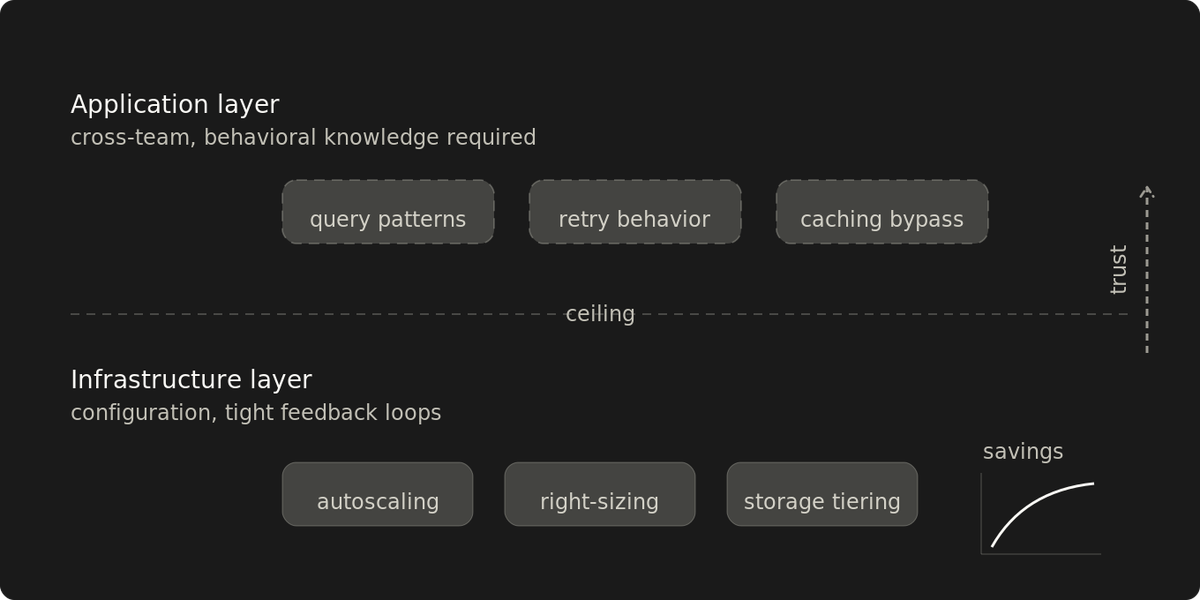
Once the configuration layer is exhausted, the largest remaining cost savings live in application code owned by other teams.
Infrastructure optimization handles the configuration layer: autoscaling, resource allocation, instance scheduling, orphan cleanup. Results land within a billing cycle. But the configuration layer has diminishing returns, and the biggest remaining cost driver usually isn't in the configuration at all. It's a query pattern or a caching decision within a service another team owns, and fixing one of those can save more than all the autoscaling changes combined.
The cheapest savings land first. The biggest ones come last, because they depend on the knowledge and credibility that infrastructure work builds.
The configuration layer has a ceiling
The signal is in the type of remaining opportunities. When every change yields single-digit improvements, and the remaining cost drivers are all application behavior, the configuration surface is exhausted. Traffic growth can mask this. A flat bill doesn't mean the limit is reached if new workloads absorb the gains. The diagnostic is the opportunity set, not the bill trajectory.
Below that ceiling, infrastructure work generates more than cost reduction. Fleet cost reporting surfaces which services burn disproportionate resources and where traffic concentrates. Default autoscaling reacts after load climbs, adding capacity once the spike has already passed and users have already timed out. Replace it with something that anticipates the daily traffic shape, and you learn why a service is sized the way it is, and which scaling patterns signal application-level waste. Cost attribution shows what's expensive and when.
What cost attribution and fleet reporting don't show is the cost rationale: why an allocation is that big, and whether it's right for a workload that only peaks a few hours a day. A trace can surface which service drives a downstream load. It still can't tell you whether that load is worth what it costs. That rationale is what explains a database tier staying provisioned for a peak that only one service's retry logic creates, or a cost spike that lines up with a batch window.
The cost rationale never shows up on a dashboard
Infrastructure tuning teaches you that rationale as a side effect. Each anomaly you chase ties a cost spike to a specific interaction pattern, until you know why each resource is sized the way it is, which no dashboard shows. You only learn it when you try to change it.
Demonstrated results change how teams receive proposals
The team that owns the application code needs to verify that the analysis is accurate and that the proposed trade-off holds under production conditions.
Mandated changes without that track record produce compliance. The owning team makes the minimum change that satisfies the requirement and no more. When your platform work already shows up in their cost reports, that same team engages: it tests the trade-off against its own understanding and often proposes a version that saves as much at lower risk. Going over the team to management is the nuclear option, and it costs even when it works: the argument you win still damages the relationship.
A cost reduction that shows up in the monthly report changes the conversation. The platform team's track record is already in the budget data when it asks teams to change their code.
Cold proposals stall on the questions you can't answer
Analysis built from cost attribution alone references behavior the analyst never watched happen. The owning team asks the questions attribution can't answer. Why is the allocation that size? What happens during the batch window? Does the change ripple into a downstream dependency? A cold proposal has no answer ready—the proposal stalls.
When the analysis misses something, the correction comes from the owning team, and building from their corrections is slower than building from work you did yourself.
Meanwhile, infrastructure savings that require less cross-team coordination sit untouched. The initiative spent its early credibility budget on a cold proposal. Pressure for visible progress goes unanswered.
The early wins create what the later work needs
Infrastructure work requires less coordination and is usually the most practical way to earn both at once: the knowledge of why each resource costs what it does and a visible win on the cost line. Application-level work needs both.
Infrastructure changes land within a billing cycle. That matters when leadership wants progress on the cost line this quarter.
You've hit the ceiling when the top cost drivers all live in application code. You're ready to go above it once you can describe a service's cost behavior, the owning team recognizes the description as accurate, and starts asking what to change. The strongest signal comes later, when teams bring you cost questions unprompted.
Skip the small wins, and the big ones stay where they are: in code you have no standing to change.