The business model is the ceiling
When the business model is the constraint, execution discipline raises the ceiling without breaking it. A diagnostic for model constraints.
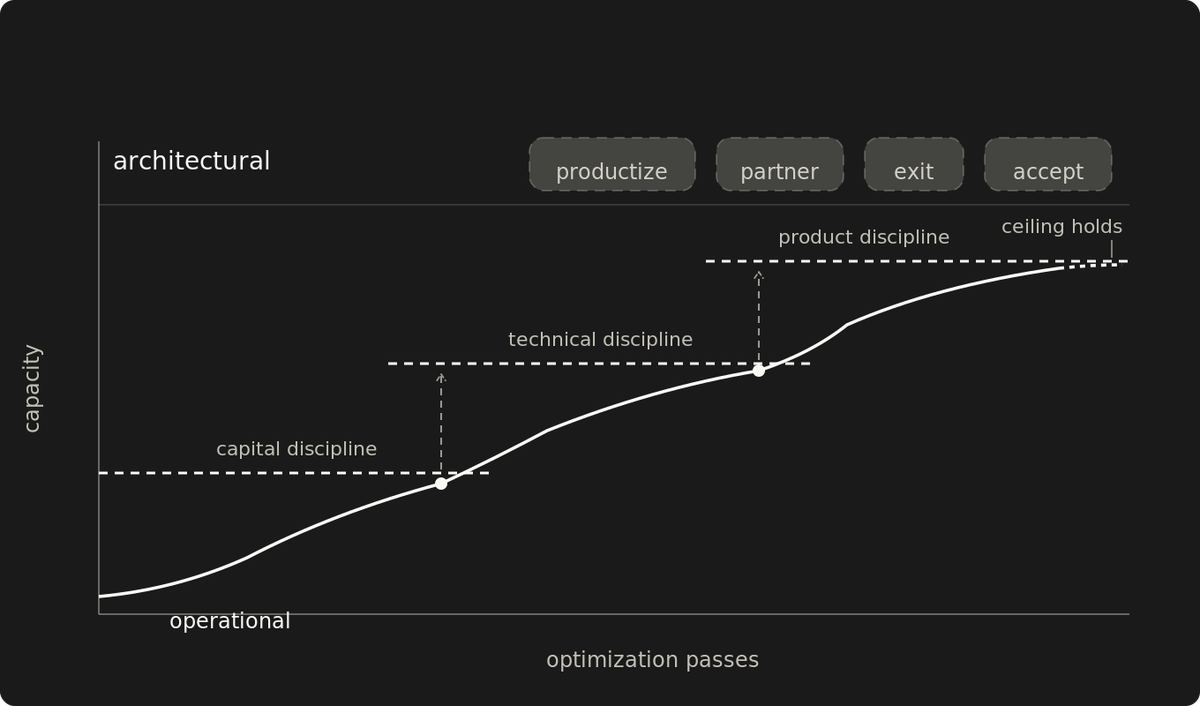
Effort raises a structural ceiling. It doesn't break it.
One question tests for a business model constraint: does adding capacity require the resource that's already saturated? When yes, the model is the ceiling. In a custom delivery business, that resource is senior attention, and hiring consumes it. Working harder reproduces the ceiling at a different scale of effort.
The shape of the trap is a closed loop: hiring requires revenue, revenue requires capacity, and capacity requires hiring. Without external capital, the only resource that can grow capacity past the linear limit is the one already at saturation. Every execution improvement runs through that resource. The ceiling rises with the improvement and binds again at the new height.
Why proportional cost growth caps revenue growth
Linear conversion keeps the constraint alive even after productivity improves. One more unit of revenue still requires one more unit of input from the bound resource. Code reuse raises productivity, and so do automation and tooling discipline. None of them change the linearity.
Custom work for individual clients converts linearly. Each client requires requirements analysis, architecture, development, deployment, and support. Reuse covers some of it. The unrecoverable parts scale with client count. The ceiling is whoever has to do that work: founder capacity in a solo-operator service business, senior delivery capacity in a small flat-hierarchy team.
A productivity gain that lets four clients run on three engineers' worth of effort raises the ceiling. At 8 clients, capacity binds. At 16, again. It still binds.
The lock survives execution discipline
Three forms of execution discipline applied across the operation. The ceiling rose with each gain. It held.
Capital discipline: no outside investment beyond starting capital. No debt. Cash was not the only input. Prepayments and milestone billing could have funded a hire. The hire would still consume months of operator attention before producing net capacity. The loop stayed closed for the duration.
Technical discipline: 60-80% code reuse across the portfolio through a hybrid model: proven architectures repackaged per client. The model raised the productivity of the bound resource. It didn't change which resource was bound.
Product discipline: a multi-tenant SaaS platform on top of the existing codebase. Six modules. 95% code reuse from proven systems. Every hour of building, marketing, iterating, and supporting came out of client delivery. Productization needed attention up front. It competed with delivery for the same scarce input. Productization only breaks the lock once the product runs without the producer. During the build, it consumes the bound resource like anything else, and this one never crossed into that phase.
The lock survived all three. It breaks only when the model changes.
The exits are architectural
Four moves go beyond working harder. Each answers the same question: does this change how capacity is created? External capital can front-load capacity, but it doesn't change linear unit economics. It can fund two of the exits, Productize and Partner. Capital alone, applied to a bound model, lifts the ceiling and leaves the lock in place.
Productize. Detach delivery from the bound resource. Move from selling capacity (hours, headcount, senior attention) to selling instances of a product that runs without the producer once it's built. Cost grows slower than revenue on delivery and support, and the bound resource doesn't scale with each new sale. Acquisition is the exception: it can still climb as cheap channels exhaust, which is why productizing trades a delivery ceiling for a go-to-market one. Custom development relabeled as a "product" still scales with input.
Partner. Externalize capacity. The partnership only changes the ceiling when delivery and support ownership moves with it: white-label, some reseller deals. Lead-generation alone shifts acquisition without relieving the bound resource, and marketplace or integration deals that move only acquisition behave the same way. The model still scales with input, but the input is no longer the team's. The hard part moves into the relationship: who owns delivery, who owns the customer, who carries the support load.
Exit. Move the skill into a model with existing capacity: an employer, an acquirer, or a platform with built-out distribution. The ceiling moves because the model changes. The skills survive the transition. The bound resource type changes with the model.
Accept. Optimize inside the known bound. Acceptance is a coherent strategic choice when the bound model's lifestyle and margin profile is the goal. It stops being coherent when the operator conflates it with execution: running optimization passes against a structural ceiling, and reading the absence of a breakthrough as a discipline problem.
Three of the exits restructure the way the model converts inputs into outputs. Accept keeps the conversion as it is. The choice lies at the architectural level, but the work beneath it is entirely operational. Optimization passes are operational. They squeeze the existing conversion. When optimization stands in for architecture, the result is years of effort that scale the ceiling without breaking it.
The diagnostic
The diagnostic is binary. Does adding capacity require the resource that's already at saturation? If no, this capacity loop isn't what's binding, and the constraint is elsewhere: distribution, demand, or the size of the addressable market. If yes, the model is the ceiling.
When adding capacity requires the bound resource itself, the next decision is architectural rather than operational.