Procedural risk shrinks; structural risk doesn't
Some risks shrink with effort. Others absorb the same investment and don't move. One question tells them apart during evaluation.
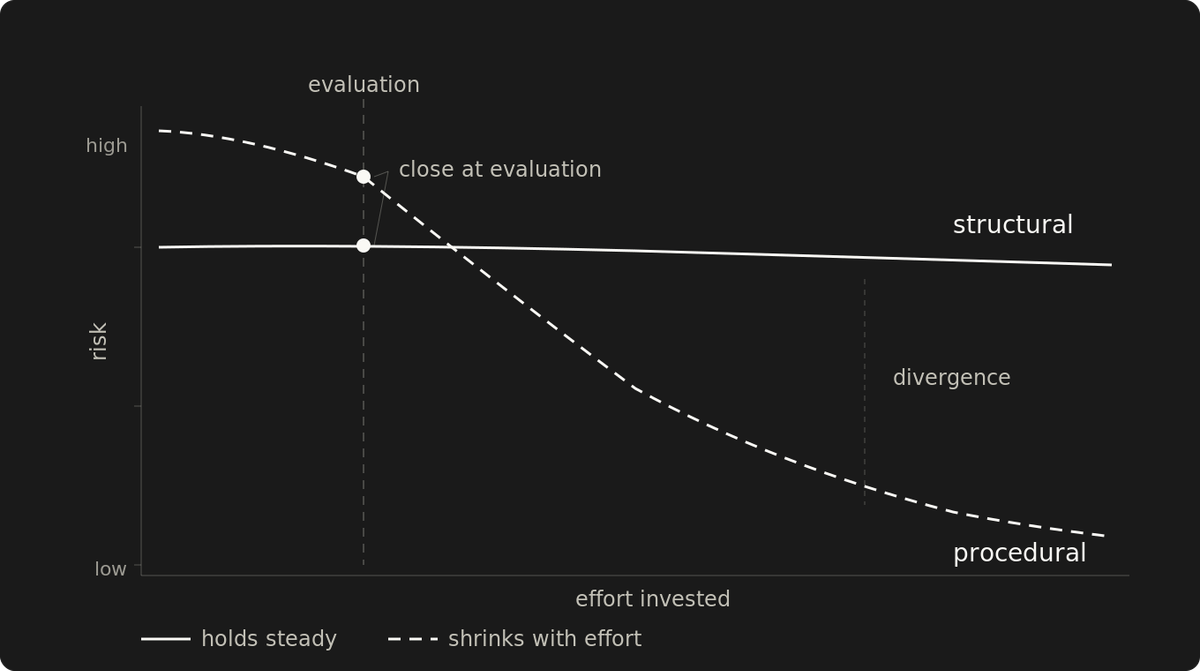
Risks have trajectories.
Some unknowns shrink with effort. A platform the team hasn't operated before becomes familiar through exposure. The gap between what the team can do and what the platform requires closes with practice. The risk points down.
Other unknowns don't respond to effort at all. A platform that can't meet the scale requirement won't, no matter how hard the team tries. Training and practice don't change architecture. The constraint holds steady while the cost of removing it compounds.
The distinction matters because risk evaluation treats unknowns as a single category, pricing the gap that closes with investment the same as the one that absorbs it and stays.
Procedural risk shrinks with effort
Procedural risk is a skill gap: the distance between what the team knows today and what the platform demands. It shrinks with time, though complex platforms have plateaus that make early progress a poor predictor of the finish line.
The ramp doesn't have to precede the work, either. Sequence a rollout from low-stakes to high-stakes, and the early phases train the team for the late ones. The fluency the final phase demands gets built inside the project, on the project's own clock, while the deliverables that phase depends on are shipping.
The worst case is bounded: the ramp takes longer than expected, and early decisions often need revisiting later. Scaffolding from the learning phase sometimes hardens into permanent architecture, and from the outside it looks like a structural workaround.
The difference is reversibility. Scaffolding on a platform that meets structural requirements is refactorable. The team that built it gains fluency as it goes, and the foundation supports the rebuild, as long as the rebuild stays inside the structural envelope you screened for. Workarounds on a structurally limited platform persist regardless of expertise because the constraint lies in the platform's foundation.
Structural risk doesn't respond to effort
Structural risk is an architectural constraint. The system can't do what it needs to do.
The resolution path is architectural change: replacement, re-platforming, or a redesign deep enough to remove the constraint. Single-failure-domain architectures remain exposed to correlated failures, no matter how much redundancy is within that domain.
Structural limitations often present as operational problems. A team hits a throughput ceiling on the platform they chose for its familiarity. They profile, optimize the hot path, and add a caching layer. Read latency drops and the graphs move. Write throughput remains where it was because every write still funnels through a single serialization point, and nothing on the read path reaches it.
Push harder, and the shape becomes clearer: past the ceiling, latency stops falling and starts climbing as offered load increases, while throughput remains flat. A quota you could raise or a pool you could resize would have moved. This one doesn't, because the limit lives in the platform's architecture, below the application code and beyond any setting you could change. The team stays productive throughout because the constraint lies outside the current milestone's scope.
A vendor might ship a capability that removes the ceiling, but that runs on someone else's roadmap—a windfall, not a mitigation strategy.
Investing effort in structural risk delays the diagnosis. Everything the team builds on a limited foundation carries the replacement cost forward, growing with each dependency.
Familiarity masks structural limitation
The expensive failure is classifying structural risk as procedural. The familiar option has a structural limitation invisible at the current scale but present in the target architecture. The unfamiliar option meets structural requirements but demands a learning investment. Under a risk-level comparison, familiarity wins.
The comparison fails because it prices both risks at a single point in time, and the project lives on their trajectories. The familiar platform's limitation stays put while the unfamiliar platform's learning curve shrinks with exposure. Six months later, the team on the unfamiliar platform is shipping. Expertise on the familiar platform has produced workarounds for a limitation that remains.
Workarounds accumulate incrementally, each one adding a dependency on the limitation staying in place. The total becomes visible when someone asks what replacing the foundation would take.
One question separates procedural from structural risk during evaluation, before committing resources: if the team had full expertise on this platform tomorrow, would the risk still exist?
The answer comes from the platform's architecture: design constraints, scaling boundaries, and how it should behave under your workload pattern. You get that from documentation and a bounded spike. Instinct carries the familiarity bias the question is designed to bypass.
If the answer is yes, the risk is structural, and no ramp time resolves it. If the answer is no, the risk is procedural, and the remaining question is whether the ramp fits the calendar.
A deadline can make procedural risk unaffordable
The calendar determines whether the team can act on the classification. Deadline pressure is the norm, and a procedural risk that exceeds the available calendar is still procedural. The team could master the platform given enough time. That doesn't help when the ramp needs 12 months, and the deadline is 6. Worse, deadline pressure masks the misclassification.
The trajectories are asymmetric. Procedural risk shows its cost from the start: slower velocity, mistakes during the ramp, and reduced confidence. Structural risk shows early velocity that looks like validation.
Features ship and milestones land, because the structural boundary sits outside every current milestone's scope. Every progress report reinforces the original platform decision. Early progress on a structurally limited platform looks indistinguishable from early progress on a sound one. The divergence surfaces later, when it's expensive.
The trajectory was structural the whole time. Ask the question before you commit to the platform.